
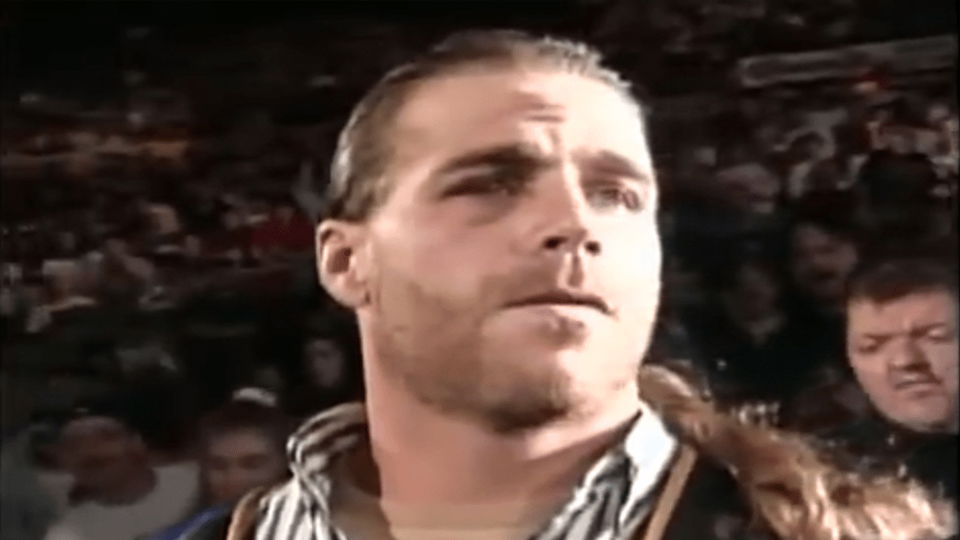
In 1995, Shawn Michaels was a troubled 30-year-old, weighed down by a hefty expectation on his shoulders to carry the floundering WWF through its leanest period. Pain pills and alcohol were the vices he indulged in to block out the ever-increasing resentment he faced from his peers in the locker room. Shawn’s demons made him belligerent, often leading to bust ups backstage and trouble on the road. When his Kliq bodyguards Diesel, Razor Ramon and Triple H were with him, Shawn was safe, protected from his own mouth. When Shawn was left to his own devices, the results could be disastrous.

On October 13, 1995 Razor, Diesel, and Hunter were on a European tour while Shawn was on the road on a north-eastern house show loop. Following an event in Binghamton, New York, he rode with fellow Kliq ally Sean ‘1-2-3 Kid’ Waltman and Davey Boy Smith—the man he had wrestled that night. Upon checking into Motel 8 in Syracuse, the city hosting the following night’s live event, a group of fans overheard the trio discussing their desire to party through to dawn and offered to drive them to late night haunt Club 37 in the north of the city.
Looking to make up for lost time with little over an hour to go before the venue shut its doors for the evening, the trio quickly loaded up on a dangerous cocktail of shots and somas. Searching for a hook-up for the night, Michaels took a shine to a pretty girl on the dance floor. He began to make his move, raising the ire of 23-year-old solider Douglas Griffith, who used to date the girl Michaels was pursuing. Jealous at the attention the “phony wrestlers” were receiving from everyone in the club, Griffith stepped in and firmly warned Shawn that he and the young lady he was dancing with were an item. Michaels ignored him and continued to drunkenly chase the girl, asking her back to his hotel room.
Club bouncer Tony Alberti had a finely- tuned sense for impending trouble and could see something brewing between Michaels and Griffith. Not wanting a headline-making incident on his watch, Alberti asked his girlfriend Donna Jones to drive the wrestlers back to their hotel before things got out of hand. By now, Michaels had overindulged so much that he was unconscious, leaving Waltman, Smith and Donna’s brother Richard to drag him to her two-door Pontiac Sunbird and place him in the passenger seat.
Griffith and two of his fellow servicemen were lurking in the shadows of the car park, waiting for them. Coincidentally, he already knew Donna, who was friends with the ex-girlfriend that Shawn Michaels had been chasing. “What are you hanging around with those loser wrestlers for?” he chastised, “They are all a bunch of fakes.” Smith had heard enough and lunged forward from his middle seat, landing a glancing punch on the back of the serviceman’s head. As Griffith recoiled with surprise, Michaels threw a weak shot of his own towards the irate soldier.
That was the excuse Griffith needed to stand up for himself and fight back. He yanked Michaels’ semi-conscious body from out of his seat, hurled him into the car, then slammed the door closed onto his head. Michaels fell to the floor where Griffith continued the assault, kicking him in the face with his army issued steel-capped boots. Waltman and Smith attempted to escape the car to assist their fallen comrade, but a lack of rear doors and their intoxicated states rendered them useless— especially with Griffith’s two friends manning the front doors to prevent their escape. Eventually breaking free, Waltman proceeded to throw worked karate kicks before crumpling in a pitiful heap. Smith too escaped the confines of the car, managing to drag Griffith off Michaels until he was prised off by the two soldiers. In the fracas, an errant finger almost inadvertently poked out his eye.

Finally, Donna was able to run away and tell Alberti, who stepped in with another bouncer and broke up the fight. Worried that the assailants would return armed, Alberti called an ambulance and told Donna and Richard to take the wrestlers back to their hotel, where they were met by paramedics and taken to nearby St. Joseph’s hospital. Michaels was diagnosed with a torn eyelid, minor lacerations to his face, two black eyes, and bleeding from his ears where his earrings had been torn out. Smith needed stitches in his face and had a bloodshot black eye. Waltman escaped with only his pride damaged.
The rest of the Kliq were furious when they learned about what had happened, reading Smith and Waltman the riot act for not protecting Shawn better. Both pleaded their innocence, admitting to being as drunk as Shawn was and barely able to remember what had happened. Vince McMahon was similarly infuriated, increasingly tired of Shawn getting caught up in situations like this. He was also livid that Michaels and Smith had broken kayfabe by working a match with each other then going out drinking together. In those days, things like that still mattered. The old school veterans were more disgusted that Shawn had lost the fight. As Jim Ross explains, “If you lost a bar fight back in the day, you got your notice.” Recently-departed booker Bill Watts, who only resigned from his position the morning of the Syracuse incident, said that if had occurred on his watch he would have fired all three for being on the losing side.
Shawn Michaels and McMahon tried to save face by concocting a tall tale about the events in Syracuse. The story that played out on WWF television was very different to what had actually happened, with the one young corporal and his two friends becoming eight unprovoked Marines, and all mention of drink or drugs removed from the recantation. Griffith’s lawyer Robert Mascari saw through the charade and decided to fight fire with fire, warning that from his findings Michaels would be exposed as a liar and a fraud if the case went to trial. Going for the jugular, Mascari informed the prosecutor of his intention to bring up the effects of steroid and drug use in wrestling as part of his defence strategy, pointing out that if the case went to a grand jury Michaels would be subpoenaed and force to hand over his medical records. Rightly concerned at the prospect of another messy inquest into drug culture in the WWF little over a year after being cleared on steroid charges, McMahon advised Michaels to quietly drop the case. In May 1996, Shawn officially decided against pursuing legal action.
McMahon turned the real life assault into an angle to build sympathy for Michaels. It led to Shawn winning the 1996 Royal Rumble then going onto capture his first WWF Championship at WrestleMania XII. “The whole thing worked out well for Vince and Shawn,” notes Mascari, “It made them both millions.”
Are you a fan of Shawn Michaels? Let us know on Twitter!
Comments.
Loading comments…