
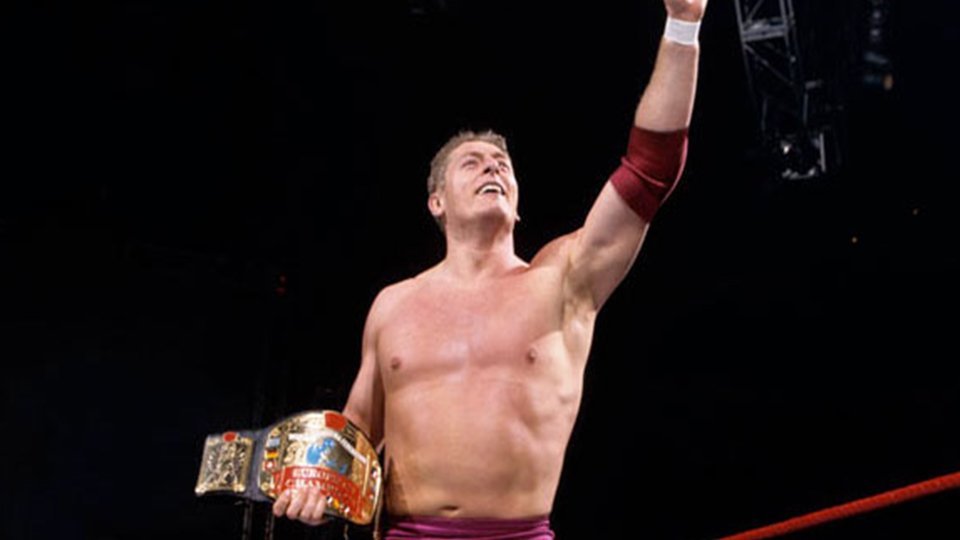
In modern era WWE, title belts are ten-a-penny. A plethora of leather and metal accolades dot the landscape, with almost everyone on the roster given a turn at carrying one of them at some point during their run with the company. It was not always that way. There was once a time when championship belts were highly sought after property that actually meant something––just ask Bret Hart and Shawn Michaels.
In the 80s and 90s, there were only three titles of note in the WWF: the WWF Championship, the WWF Intercontinental Title, and the WWF Tag Team belts. Occasionally a new title would be created as a gimmick for house shows and international partnerships––such as the long-forgotten WWF Canadian strap (which existed to showcase Dino Bravo on Montreal house shows), the Million Dollar belt (Ted DiBiase’s custom title that he carried and defended but was not recognized by the WWF) or the mysterious WWF Intercontinental Tag Team Titles (which came into being as part of the WWF’s brief union with UWF Japan).

So when the idea for a new championship that would sit alongside the three big ones was concocted, fans were understandably excited. That title was the WWF European Championship, a belt that was intended as a showcase piece that all of Europe could be proud of. With the WWF struggling domestically at the time but still drawing well overseas, they needed their European audience to prop them up more than ever.
The third singles title would also serve as a potential way for Vince McMahon to soothe some egos. The WWF and IC titles were desirable commodities. Those who carried them commanded a significant amount of political clout and backstage stroke. Wrestlers by their very nature are egocentric and many saw being chosen as the man to carry either belt as validation from the boss. With the locker room at the time as toxic as it had ever been due to backstage cliques, petty squabbles, and everyone feeling the brunt of WCW’s television dominance, it was a powder keg environment.
Although it seems ridiculous now, who carried the titles was still an important factor to most and certainly still the cause of rifts and rivalries if the quote-unquote wrong person was selected in the role. With a third option, McMahon was giving himself more breathing room, an extra bargaining chip that he could bring to the table to assuage a disgruntled employee. It also opened the door to those further down the pecking order who were not over enough to warrant a run with the IC strap––the realistic peak for the majority of the midcard––giving them a viable target to aim for. On paper, it was a no-brainer to introduce the new gold.
The European title could hardly have got off to a better start. Rather than simply awarding the first incumbent with the belt or creating a mythical tournament in Rio de Janeiro (as they had with the launch of the IC title), the WWF held a multi-show tournament during their February Xpress Tour in Germany. The names involved gave a clue to how seriously the promotion was taking their new trinket; the entrants list read like a who’s who of modern greats. In the first round, the British Bulldog downed Mankind, Vader beat Rocky Maivia, Owen Hart dropped Flash Funk and Bret Hart upended Triple H. Davey Boy and Owen––the reigning WWF Tag Team Champions at the time––came through their semi-finals to set up a meeting in Berlin on February 26, 1997, that would air on the following week’s Raw.

The 17-minute match was a technical classic, to this day one of the best matches ever held on the show. Considering that covers 25 years and several thousand matches, that’s high praise indeed. Fittingly it was Wigan-born Englishman Davey Boy who walked away with the gold, beating Hart––who had kicked out of Bulldog’s patented running powerslam––after reversing a victory roll.
As good as the match was, the rating for the taped broadcast did not reflect the quality. Raw pulled a 1.9, one of its lowest ratings ever, causing McMahon to flip his lid and declare that wrestling “wasn’t working” and that it was time to take his company in a new direction. Over the course of the next year, that direction would become known as the Attitude Era.

The European Title was rarely defended over the next several months, outside of a rematch between Bulldog and Owen the on March 31, with the WWE United Kingdom Championship currently taking centre stage, 1997 episode of Raw. The bout went to a no-contest when––with the referee down and both men looking to take out the other with a steel chair––Bret Hart came to the ring and talked the brothers-in-law into settling their differences and joining him, which led to the birth of the Hart Foundation faction.
Although happy for Bulldog to carry the belt on television, the WWF wanted to save his title defences for shows on European soil. That way they could market Bulldog––who was a huge name in Europe––as a headline attraction, with the added bonus of having something tangible on the line in his matches.
Bulldog’s first major defence came at September’s excellent One Night Only pay-per-view from Birmingham, England. His opponent that night was Shawn Michaels, who at the time was public enemy number one behind the scenes with the Hart family due to various controversial unscripted comments he had made about Bret. Smith had been told six weeks prior that he was winning the match and was so confident that McMahon’s mind would not change he told local press that he was dedicating his performance that night to his dying sister Tracy.
Only hours before the match, McMahon broke the news that Davey was losing. McMahon explained that he wanted to build to a rematch on the next UK tour in April in which Bulldog would win back the title in his (worked) hometown of Manchester. Smith was powerless, left with no choice but to go along with the new plan. In a time before mobile phones, Davey had no way to tell his family of the booking change. They were left devastated and Smith heartbroken when Tracy––shocked by her brother’s defeat– broke into tears at the bout’s conclusion. The rest of the fans threatened to riot, pelting the ring with garbage as they loudly voiced their displeasure at the result.

Most in the back pointed the finger at Michaels for the abrupt change of plans. The story was given credence by an incident only weeks earlier where Shawn had flatly stated to a gobsmacked locker room that he was not willing to do jobs for any of them. Ultimately the decision had nothing to do with Michaels, rather it was a McMahon judgment call to pre-empt any potential fallout from his upcoming contract talks with Bret Hart.
When Shawn Michaels also became WWF Champion at Survivor Series ’97, the European Title became an immediate afterthought. With Davey Boy walking out of the promotion in support of Bret following the infamous Montreal Screwjob, the WWF needed a new direction for its third singles belt. What they opted to do over the next several months caused almost irreparable damage to the title.

First, Triple H beat his D Generation X running buddy on Raw in a 77-second abomination. On-screen commissioner Sgt. Slaughter was fed up of DX’s antics and elected to punish the duo by placing them in a one-on-one match for the title. After first acting like they might fight, Michaels and Hunter reverted to type and began larking around. Michaels then intentionally laid down for his partner, handing him the title.
The belt endured another credibility-shattering episode in January when Hunter seemingly weaseled his way out of a title match against Owen Hart on Raw by employing resident cosplay act TAFKA Goldust to wrestle as Hunter-dust in his stead. When Owen beat Goldie with a sharpshooter, Slaughter decided that Owen was the new champion. It was utter nonsense. In under a year, the European Title had gone from the focal point of an all-time classic match to just another worthless prop to be passed around.
Year two of the title’s existence started badly when Triple H became a two-time champion following a 52-second match with Owen on the March 16, 1998 Raw. Owen was scheduled to defend the belt against Hunter at WrestleMania but was goaded into putting the belt up for grabs sooner, despite suffering from an injured ankle. Hunter locked a submission on the injured foot right away and referee Tim White called it off for the sake of Owen’s future career. As an angle it was fine. That it happened in such close proximity to the other two farcical title switches left a bad taste.
Hunter held onto the gold for another four months until coming a cropper against Nation of Domination underling D-Lo Brown on the July 20, 1998 episode of Raw. Distractions from Mark Henry and a Rock Bottom from Nation leader The Rock allowed Brown to pick up the surprise win. Rather than devalue the title, Brown’s win actually elevated it. He carried the gold with such pride and worked so hard in the ring that the title’s stock improved.

D-Lo traded the strap with DX member X-Pac in September and October, a rivalry that ended with Pac as a two-time champion following a spirited encounter at Judgment Day ’98. It was expected that Pac would defend the title at December’s Capital Carnage pay-per-view from London but instead, he challenged The Rock for his newly won WWF Championship. It was a slap in the face for the European Title that rather undermined its reason for existing in the first place. The fact was, domestic business had picked up so much that the WWF did not need to fall back on its overseas audience anymore.
X-Pac carried the strap into 1999, by which time he was embroiled in a surprisingly captivating feud with non-wrestler Shane McMahon. Unfortunately, the WWF took it a step too far. In a piece of booking that would eventually set the title back to square one, Shane pinned X-Pac in a Raw tag match which meant that as per pre-match stipulations he became the European Champion. For the next month, Pac and McMahon waged war, with the European Title the focus of their rivalry. As had been the case with D-Lo, the seemingly unworthy champion had actually been a positive for the belt. That all ended on Sunday Night Heat on March 30, 1999, when Shane retired the title, declaring that he wanted to go down in history as an unbeaten champion.

If that had been the end for the European Championship it may not have been so bad; the title probably would have been looked back on with relatively fond memories, despite the brevity of its existence. Alas, that was not how the story ended. In June 1999, lowly Corporate Ministry scrub Mideon––formerly the hapless Phineas Godwinn––found the discarded title in Shane’s duffel bag. Now that he no longer had a use for the Euro strap, Shane was more than happy to gift it to Mideon. It was another nail in the title’s coffin.
Step forward D-Lo Brown again, who returned to the fore at Fully Loaded ’99, defeating Mideon in a horrible match to begin his third run with the gold. Alas, even he was unable to restore the title to its former glories. The floundering belt was further damaged when Brown captured the Intercontinental Title, becoming the first ‘Eurocontinental’ Champion. Grouping the European belt with the far more prestigious IC strap further highlighted that it was an afterthought, a stepping stone title to another stepping stone title.
Jeff Jarrett’s one-day reign––he beat D-Lo to win both titles at SummerSlam––hardly helped. Nor did Jarrett giving away the European belt to Mark Henry the next night on Raw as a thank you for helping him win the IC title. For those keeping score, that was now the fourth time the title had been awarded to someone who had not beaten the champion. It sent a very clear message: the European Title was so worthless that its holders would rather give it away than carry it around.
Henry’s run was also brief, typical of the era, as he lost to Brown at Unforgiven the following month. When the WWF returned to the UK for Rebellion in October 1999, Brown faced IC champ Jeff Jarrett. Logic would dictate that Brown defend the European Title but a coin toss determined that only Jarrett’s IC strap was up for grabs and ‘Double J’ retained.
Then came a sliver of hope. Davey Boy Smith––who had settled his differences with the WWF and returned in late 1999––was thrust into the European Title picture, defeating Brown on SmackDown to become two-time champion. With the British Bulldog back at the helm, things were looking up. Unfortunately, Smith was a shadow of the performer he had been only two years earlier, thanks to an errant landing on a gimmicked WCW ring (a trapdoor had been inserted into the ring to allow The Warrior to magically appear from nowhere) that had briefly left him paralyzed. Bafflingly, the WWF decided to turn Bulldog heel. He was given an Attitude Era makeover, casting off his classic tights and iconic ‘Rule Britannia’ entrance theme in favour of jeans and a generic rock dirge.

The my-turn-your-turn booking of the European Title continued at Armageddon on December 12, 1999, when Val Venis defeated Bulldog and Brown in a triple threat match, the eighth changing of the guard that year. Val enjoyed the longest reign since X-Pac (a heady 58 days), though did not defend the gold on pay-per-view prior to his SmackDown title loss to newcomer Kurt Angle in February. Angle celebrated his win with such gusto that it briefly restored the battered championship’s credibility.
Angle became the third Eurocontinental Champion when he downed Chris Jericho at No Way Out, only this time the combining of the belts was a welcome boon for the ailing Euro strap. He defended both belts in a two falls triple-threat match against Jericho and Chris Benoit at WrestleMania 2000. Curiously, the IC strap was on the line first, which further elevated the worth of the European Title. Angle lost both of his belts without dropping a fall. Benoit pinned Jericho following a diving headbutt to lift the IC title and Jericho returned the favour with a Lionsault to capture the European belt.

The hot potato continued the next night on Raw when Eddie Guerrero beat the new champion courtesy of interference from Chyna. Although Jericho’s short run was exactly the opposite of what the title needed, Guerrero was the perfect man to immediately restore its credibility. A supremely gifted worker capable of excellent promos, Guerrero made the European Title seem like a prize he was proud of carrying. Guerrero even restored the idea of defending the title in Europe, defeating Jericho in a rematch at Insurrextion.
With Guerrero at the helm, the WWF allowed the European belt to feature regularly on television and pay-per-views. Guerrero defended the title in cracking scraps with Essa Rios at Backlash and in a fun triple threat with Radicalz teammates Perry Saturn and Dean Malenko at Judgment Day, before dropping it to Saturn in a somewhat disappointing bout at Fully Loaded.
Guerrero’s stellar work to make the European Title feel important again was quickly undone when Al Snow got his hands on the belt in August and it was once again used as a catalyst for lowbrow comedy. Snow took to entering the ring billed from a different European country each week, walking the aisle to a nation-specific theme while dressed in stereotypical native garb. Although entertaining in its own right due to Snow thrusting himself into the gimmick, it was a far cry from the well-worked wrestling-orientated performances from Messrs Angle, Jericho, and Guerrero. Snow’s run simply reinforced that the European title was a go-to prop for the writers’ zany sides.
Step forward British mat veteran William Regal, who had recently returned to the promotion from WCW. Dropping the disastrous ‘Real Man’s Man’ gimmick that he had portrayed in the WWF during his first run in 1998, Regal became a stereotypical British snob, a role he was very accustomed to after years competing as blue-blooded aristocrat Lord Steven Regal in WCW. Regal ended the Al Snow silliness on October 16, 2000, putting away the champion in just 3:39 on Raw with his Regal Stretch submission finisher to become only the second European to ever wear the belt.

Unfortunately, his first pay-per-view challenger was Mideon, with the former champion now doing a gimmick called Naked Mideon that saw him wrestle clad in just a thong, a fanny pack and a pair of boots. The pairing was designed entirely around having Regal emote disgusted facial expressions as he tied up with the nude buffoon. Once again, WWF writers had resorted to cheap comedy antics rather than allowing Regal––a gifted mat technician in his own right––to demonstrate his wrestling skill-set.
After overcoming Hardcore Holly at Survivor Series (albeit via DQ), Regal became the first European-born title-holder to defend the strap on European soil since Davey Boy Smith lost to Shawn Michaels at One Night Only, putting the gold up for grabs at Rebellion in Sheffield.

Despite his heel status on regular WWF programming, Regal should have been portrayed as a homecoming hero in front of his fellow countrymen. That’s what the fans in attendance wanted and expected too, evidenced by the monster ovation Regal received when he appeared onscreen for a backstage interview with Michael Cole. It quickly went downhill when Regal began ripping into his fellow Brits, inexplicably establishing him as the heel for his title defence against pint-sized American Crash Holly.
The five-minute match was a nothing affair. Although the fans mostly played along and cheered Holly, it was clear from the mixed reaction Regal received when entering that they would have much preferred to support their fellow Brit. Regal seemingly won the match when the referee counted three after a face plant, only to have it pointed out by Crash’s valet Molly Holly that he had his foot on the ropes. The referee ordered a restart, Molly drilled Regal with a missile dropkick and comedy figure Crash Holly was the new champion. Unlike Shawn Michaels’ victory over the British Bulldog three years earlier, there was no outcry here. Fans had been trained for so long that the European Title meant nothing that they simply reacted with apathy. Regal, incensed at the result, attacked both Hollys after the bell and stormed off with the title belt.
Holly’s run only lasted two days––Regal regained the title on Raw in under three minutes. It begged the question why did the WWF bother changing the guard in the first place if they were going to just undo it immediately? It was a title change for the sake of a title change, yet another step backwards for the yo-yo championship.
Test, the man selected to dethrone Regal in 90 seconds on a January 2001 episode of Raw, did little to increase the title’s worth. During his 69 days as champion (remarkably the sixth-longest reign in the belt’s short history) Test did not defend it on pay-per-view. He was just another name to carry the belt, a beneficiary of the WWF’s increasingly prevalent turn-taking approach to booking championship holders.

The return of Eddie Guerrero to the helm––at WrestleMania X-Seven no less––appeared to be cause for optimism. Eddie had been a great European champion, perhaps he could repeat what he had done in 2000 and restore some value? Hardly. Eddie dropped the gold to tag team wrestler Matt Hardy on SmackDown three weeks later then failed to regain the strap at Backlash five days after that in a three-way scrap with Hardy and Christian. His win over Test at ‘Mania turned out to be the final time the European Championship changed hands on pay-per-view.
Insurrextion on May 5, 2001 did not feature a European Title defence, with the belt considered to have less value than the Queen’s Cup, a trophy made up specifically for that show to give former Euro champs William Regal and Chris Jericho something to fight over. Hardy did not defend at Judgment Day either and at King of the Ring was relegated to the pre-show episode of Sunday Night Heat for a throwaway defence against Justin Credible. Hardy and his title were considered so inconsequential that he did not wrestle on the landmark WWF vs. WCW/ECW supershow Invasion in July either, placed instead in a manager role for brother Jeff Hardy’s Hardcore Title defence against Rob Van Dam.

Hardy’s long (125 days) but almost completely worthless run with the belt came to an end on August 27. WCW’s Shane Helms, a close real-life friend of Matt’s, donned superhero garb for the first time and became The Hurricane, defeating Hardy on Raw thanks to an assist from a crowbar-wielding Ivory.
The WWF’s acquisition of WCW and all of its title belts had rendered the European Championship irrelevant. The title slipped well down the pecking order, behind the WCW World Heavyweight Championship, the WCW United States belt and even the WCW Cruiserweight Title. With interest in the belt at perhaps its lowest ebb, the WWF essentially disregarded it. It still existed, but few watching had any emotional attachment or cared about who carried it.
Bradshaw was given a token 10-day reign in October 2001, the WWF’s way of saying thank you to him for policing the locker room amidst the arrival of so many new faces. The next title change was not even televised. Although filmed as part of the November 1 episode of SmackDown, Christian’s victory over Bradshaw was edited off the show due to time constraints. It was the ultimate ignominy for the unloved belt. That was quickly followed by another UK pay-per-view, Rebellion, going by without a title defence.
In the final WWF vs. WCW/ECW Alliance battle at Survivor Series, the European Title was up for grabs with Christian defending against former champ Al Snow. The pre-show stipulations stated that anyone associated with the losing side who was not a title holder would be fired. With the invaders coming up short that night, Alliance member Christian successfully retained, guaranteeing him his job. The rest of the card saw a number of title unification bouts, which seemingly bode well for the future of the WWF’s unloved accolade.

46-year old Diamond Dallas Page became the oldest man to wear the European strap when he defeated Christian on the January 31, 2002, SmackDown, drilling the champ with a Diamond Cutter to win the first and only WWF singles title of his career. Page beat the Big Boss Man via DQ on Sunday Night Heat prior to No Way Out, clearly demonstrating that despite the glut of championships that had populated the landscape in 2001 having dried up, the European belt was still way down the pecking order. Nevertheless, the title received a last hurrah at WrestleMania, on the line in one of 11 main show matches as Page successfully retained against Christian.
Two days later, William Regal began his third run with the belt, upending DDP on SmackDown. One week later, WWE split the rosters for the first time, leaving the European Title the exclusive property of Raw. That was another positive sign for the championship, as with fewer titles to compete with the belt should have become more of a focus. Instead, the WWF had Regal lose the title two weeks later on Raw to Spike Dudley in mere seconds. It looked like the anomaly would be rectified at UK-only show Insurrextion on May 4, which could also right the wrong of Regal’s loss to Crash Holly two years prior.

Alas, the WWF ran the same play again, forcing Regal to belittle the people of his nation in an effort to get him booed against Spike. It failed even more spectacularly this time than it had in 2000, with fans angrily booing when Spike was on offence. Incredibly, Spike won the match, catching Regal with an inside cradle to retain. Furious, Regal drilled Spike with a brass knuckle-assisted punch following the conclusion, to a big pop and “Regal” chants. Highlighting what a counterproductive booking decision that was, the promotion put Regal over in another rematch two days later on Raw––the exact same thing they had done in 2000.
The title was now known as the WWE European Championship due to the World Wildlife Fund’s lawsuit victory over McMahon’s wrestling promotion forcing the WWF to rebrand to WWE. All of the promotion’s pay-per-views, TV shows, and title belts were reimagined with the new logo, except for the European belt. WWE once again demonstrably cared so little for the title that they could not even be bothered shelling out the few thousand dollars it cost to have it remade.
It soon became clear why. Two weeks after Jeff Hardy ended Regal’s fourth reign on July 8, 2002, WWE set up a ladder match between Hardy and Intercontinental Champion Rob Van Dam. There would be no Eurocontinental champion this time. The winner was to become the unified Intercontinental Champion, with the European Title ceasing to exist and its lineage becoming part of the IC title’s lore. RVD won the match and the European Title slipped out of history for good.
So what lessons can WWE learn from the European Title as pertains to its spiritual successor the United Kingdom Championship? There are already a lot of alarming similarities. Much like the European title, the UK belt started with a tournament held on European soil, which concluded with a popular victor––Tyler Bate––emerging from a hard-fought final match. The belt was then left on ice for several months, as the European Title had been. Pete Dunne’s victory over Bate in their classic at NXT TakeOver: Chicago was a useful reminder that the title still existed. However, it soon changed from its originally intended form, with Dunne defending the belt at NXT shows in the United States. At first, he faced off with Brits but that soon changed when the likes of Johnny Gargano and Roderick Strong received cracks at the gold.

Since the launch of the NXT UK brand, the title has been treated as a proper UK-based championship. With rare exception, the title is defended exclusively in the United Kingdom by current champion WALTER. The championship is also treated with the utmost respect and has been placed at the pinnacle of its own brand. It is not the tertiary championship that the European Championship was at its peak, but rather the primary championship of its own brand. For its sake, that is a vast improvement.
Were you a fan of the European Championship? Let us know on Twitter!

Comments.
Loading comments…