
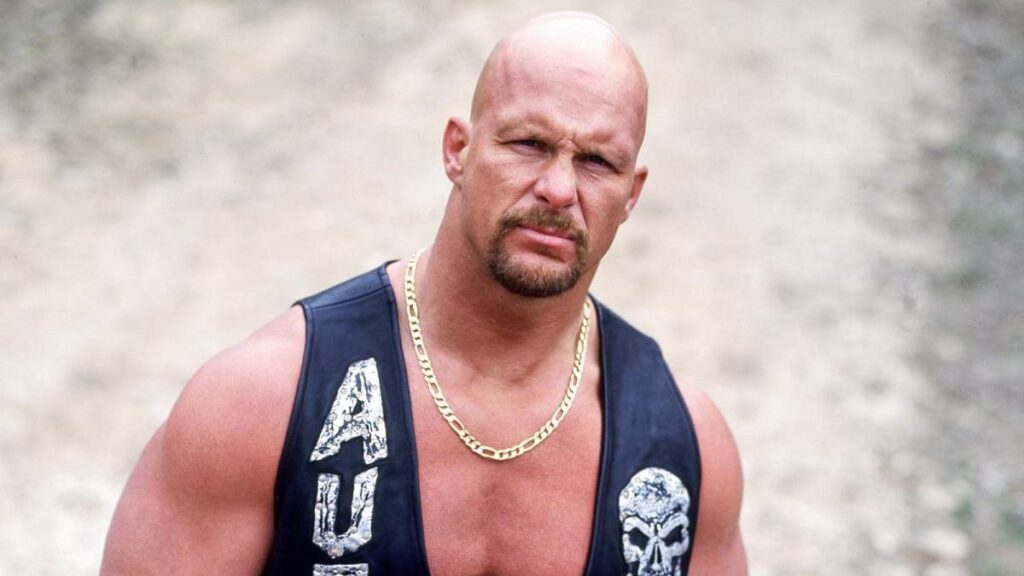
The first anyone knew about it was a filename. In March a red background image called “sk-Stone-Cold-Steve-Austin-Liv-Morgan_SectionBG_Red” turned up in Fortnite’s files, fans spotted it, and this site wrote it up more than three weeks before Epic said a word. On 13 April the official Fortnite account posted “AND THAT’S THE BOTTOM LINE… 4.16.26”, and three days later the outfit was in the item shop.
Austin hasn’t wrestled since Arlington in April 2022. He wasn’t on the card at WrestleMania 42 in Las Vegas this year. And yet in 2026 the most-discussed new Stone Cold product was a video game skin bought by people who never saw him work a live crowd. The Austin story now is about what a wrestling character does once the wrestling has stopped.
Second life in a shooter
The Fortnite outfit is a useful inventory of what survives translation. Two styles, the classic gear and the “What?” T-shirt. A back bling called “Shattered Glass”. A pickaxe called “Smoking Skull”. An emote, “The Rattlesnake’s Refreshment”, in which the beer bash is performed with cans of Slurp Juice, because Epic was never going to ship a man chugging two beers. Each one is a piece of the persona with a product name on it, and Epic did not need a ring to sell any of them.
He’d been a game character long before that, of course. Austin had his own Austin 3:16 collector’s edition of WWE ’13 in 2012, fronted WWE 2K16 three years later, and 2K16’s Showcase mode ran his career from the 1996 King of the Ring final to WrestleMania XIX as a playable campaign. Fortnite is a different kind of deal. A WWE game is selling wrestling, and the buyer already knows what a Stunner is. A Fortnite skin sells Austin to people who may not.
Why Stone Cold travels
The character was always simple, which helps. Bald head, goatee, black trunks, black boots, a vest. The entrance is the sound of breaking glass. The catchphrase is a Bible-verse parody he ad-libbed in Milwaukee on 23 June 1996 with a lip he’d split open on Marc Mero earlier in the night, and by the following May the Austin 3:16 T-shirt was being reported as the best-selling WWF shirt since Hulkamania. The beer truck the week before WrestleMania XV finished the picture. A designer could rebuild him from a text description.
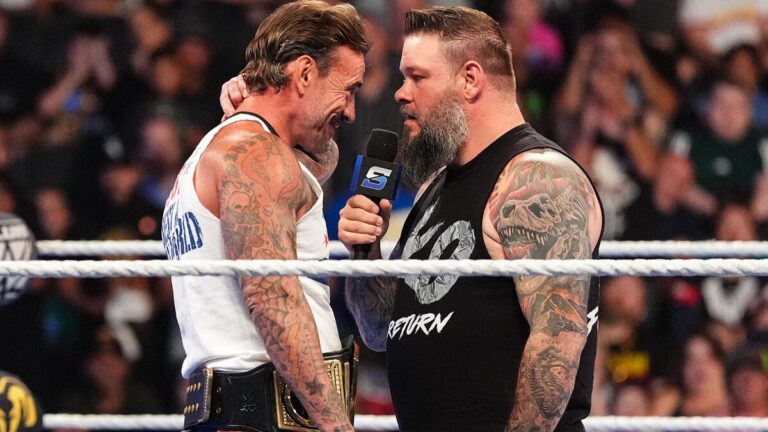
It also helps that the character never went out of date. Austin’s last match, a No Holds Barred against Kevin Owens on night one of WrestleMania 38, came nineteen years after his previous one, and the pop for the glass was, to these ears, the loudest of the weekend. At WrestleMania 41 his job was to walk out and announce the attendance, 63,226, and the building treated it as a match. A licensing department can do a lot with a man who gets that reaction for reading a number out.
From Stone Cold to the slot reels
The licensing department has been busy. TKO’s full-year results put WWE’s consumer products licensing at $136.4 million for 2025, up $25.3 million on the year, and most of that money is earned by the characters. A licensed product is a way of getting paid for a wrestler without having to book him.
Casino games are the corner of that business wrestling fans tend not to know about, and slot games online have been partnering with wrestlers for years. A licensed reel does what Fortnite did: it breaks the character into its most recognisable parts and puts them back together somewhere else. WWE Legends Link & Win, made by All41 Studios and distributed through Games Global, uses Austin, Booker T, Randy Savage and Eddie Guerrero as its high-value symbols, dresses the reels as an arena and runs the studio’s standard respin mechanics underneath. All41’s head of game design, Bradley Johnson, said the team went for “superhero-style characters” and “atmospheric arena-style sounds”, which is a fair description of what a wrestler’s entrance already is.
It is an adults-only casino product, and Austin’s only connection to it is that WWE owns the character and licensed it out. Four faces that sold merchandise on both sides of the Monday Night War are now artwork on a reel, and the company that owns them collected the fee.
Why wrestling translates
Wrestling was built for this. The characters are drawn in primary colours and the stories are told without needing the sound on. Entrance music is written to be recognised in a second from the cheap seats, and the fans stay loyal to a persona for decades after the run ends. A game developer wants every one of those things. A shooter can’t use an athlete’s mid-career form, but a silhouette, a sound and a catchphrase all fit in a locker, and wrestling makes them on purpose.
The company knows it. Raw has been on Netflix since January 2025 under a ten-year deal reported at more than $5 billion, WWE’s partnerships line grew by $76.6 million last year, and wrestlers’ second careers now run from Joe Hendry’s albums to Fortnite lockers. Not one of those deals needs Austin, or anyone else, to lace up a pair of boots.
Still on the shelf
Austin has not had a match in more than four years and the character has never been busier. He is a playable skin in one of the biggest games in the world, a campaign in a 2K title and one of four faces on a licensed reel. What a persona does when the person retires is a question wrestling will keep asking as its legends age, and on this evidence the answer is that it chugs Slurp Juice and carries on.
Comments.
Loading comments…