

You can’t swing a cat these days without hitting a WWE or AEW pay-per-view or television special named after a sorely missed grappling extravaganza from days gone by. Since the start of 2020, we’ve had Bash at the Beach, Great American Bash, Halloween Havoc, WarGames, In Your House… even the long-forgotten Vengeance (Day). To be fair to AEW, its own instalment of Bash at the Beach remains the Florida-based company’s only foray thus far into this curious nostalgia-fest.
That may have something to do with the sequence of events last year when Cody Rhodes embarked on a trademarking binge, staking a claim to famous WCW event names – many of which were associated with his dad, the late great Dusty Rhodes. WWE, which purchased WCW’s intellectual property in 2001 when the company went bust, opposed the filing and reportedly reached an agreement with Cody for him to back off. When he did, WWE snapped up Superbrawl, Slamboree, and more.
While WWE struggles to define the identity of Raw and Smackdown, recent evidence has shown NXT’s brand is focused a lot more on fan service, easter eggs, and yep – nostalgia! Triple H’s baby has become the home for heartfelt homages to the trappings of wrestling’s 80s and 90s heyday. With NXT Great American Bash just around the corner, what pay-per-view of yore should they revive next? And which should they avoid at all costs?
Avoid (5.) – Jakked

Ok, so this was a TV show rather than a pay-per-view. But while some old WWF/WWE show names and formats from years past are well worth revisiting for a nostalgia pop (i.e. Tuesday Night Titans, LiveWire), some most definitely are not.
Jakked replaced the flagging Shotgun in 1999 and was the equivalent of today’s Main Event in the pecking order. It did have exclusive matches alongside all the highlights and recaps of the real action from Raw and SmackDown.
Purely down to the somewhat, erm, questionable name it was given (it was the Attitude Era, after all), I think it’s safe to say WWF Jakked is not making a return anytime soon in the family-friendly modern WWE. And all the better for it.
Revive (5.) – WrestleRock

If it’s tongue-in-cheek we are looking for then look no further than AWA’s WrestleRock. NXT showed back in October with the fun that was had in reviving ‘Spin the Wheel, Make a Deal’ for Halloween Havoc, those in charge know full well that retro shows need the correct mix of in-ring action, well-built stories, and plain old silliness.
As the Minnesota-based company struggled (and failed) to keep pace with the burgeoning growth of Titan Sports in the mid-80s, promoter Verne Gagne scrambled around for anything that might match the famed ‘rock and wrestling’ wave. His answer? WrestleRock, a heavily promoted stadium show which promised both rock and wrestling. In the end, 23,000 fans filed in to see an unremarkable AWA card followed by a brief performance from country star Waylon Jennings.
The jewel in the crown for WrestleRock though was not the action between the ropes. Oh no. Infamy was guaranteed the moment someone decided the AWA crew should shoot a music video – a rap video no less – titled the “WrestleRock Rumble”. Among those dropping bombs in the four-minute banger are future Clique members Scott Hall and Shawn Michaels. No Triple H, sadly.
WWE has already parodied the tune a few years ago, but NXT could absolutely sprinkle its magic on this much maligned super-show of yesteryear.
Avoid (4.) – Bunkhouse Stampede

What exactly is a Bunkhouse? Where is a Bunkhouse? Why is it stampeding? Dusty Rhodes answered none of these questions back in 1985 when he unveiled his latest brainstorm – the Bunkhouse Stampede. Rhodes is credited with some of Jim Crockett Promotions’ most influential concepts, including Starrcade, the Great American Bash, and WarGames. The Bunkhouse Stampede has never joined those in the pantheon of memorable pay-per-views.
Wikipedia tells us that a bunkhouse is the name given to an old cabin or ranch where cowboys used to rest or work. So, it fits the working class, common man aesthetic that Rhodes developed for himself. As for the event itself, it was a series of house show battle royals where wrestlers wore their own clothes (a bit like a mufti day at school) and were allowed to use weapons (not like a mufti day at school). With straps, bats and chains flying about they were bloody affairs. The winners would convene in a final Bunkhouse Stampede for a championship.
The event took place annually from the mid-to-late 1980s, but only once (1988) on pay-per-view. Oh, and one more important detail – it was won by Dusty Rhodes. Every. Single. Year. Even with “The American Dream” treated as the godfather of NXT, they would be best advised to steer clear of this one.
Revive (4.) – Canadian Stampede

Canadian Stampede (technically, In Your House 16: Canadian Stampede, for the purists). It was the greatest WWE show of all time. So why not bring it back? Simple as that. The Canadian contingent of NXT and WWE’s main roster may not quite be what it was, but you could definitely scramble together a decent five-man team hailing from the Great White North to face off against five dastardly Americans.
Imagine an uneasy alliance of top US NXT stars laying down a challenge to their northerly neighbours – Kross, Cole, Gargano, Theory and Ciampa – while struggling to co-exist with each other. Kyle O’Reilly who has recently proven his worth as a singles star captains the Canadian team, calling on Roode, Owens and Zayn from the main roster for help. Chris Jericho and Brian Pillman Jr are all tied up with AEW so maybe we look further afield for a fifth man. Davey Boy Smith Jr has been rumoured to be on his way back in for a while and would make perfect sense, and receive a very emotional reaction, especially if accompanied by friends and family such as Tyson Kidd and Natalya. Or how about Edge?
Elsewhere on the original card, Triple H and Mick Foley had a wild brawl, so Uncle Paul could help build up the event on NXT by giving a heartfelt promo about… himself. And his career. Again.
Avoid (3.) – Sin

The final years of World Championship Wrestling saw the Turner-owned company throwing whatever they could at the wall in the hopes that something would stick. After trying to appeal to the biker community with Road Wild/HOG Wild, the group tried to exploit the success of the New World Order. After the Bischoff-Russo reboot, we got the New Blood. After yet another change of management, 2001 brought with it a renaming of all WCW pay-per-views, apparently invoking the biblical ‘seven deadly sins’.
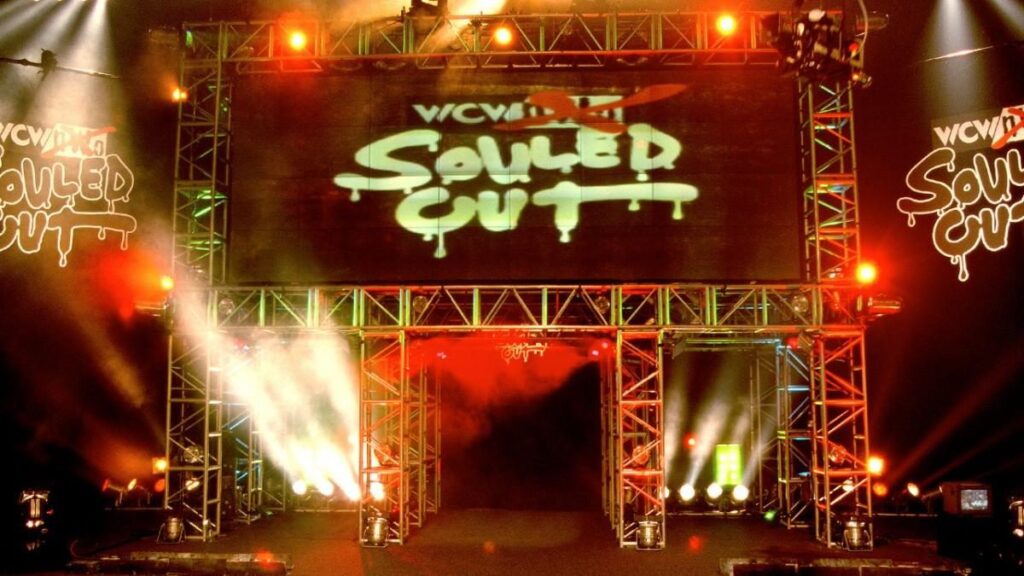
Sin took place just the once, replacing the equally pointless Souled Out in WCW’s January slot. With no real explanation of reasoning for the new themed pay-per-view names (Greed was another), fans were left to wonder if it was some cynical in-joke being made at the foolish decisions and overspending that had brought the company to the brink of extinction.
WCW Sin aired in January 2001 with such memorable classics as Shane Douglas against General Hugh G Rection in a First Blood Chain match. Ah, the memories. The only reason anyone remembers Sin, of course, is due to the horrendous leg injury suffered by Sid Vicious in the main event. Probably best for all of us if we act like Sid and forget it ever happened.
Revive (3.) – Shotgun Saturday Night

One from the ample back catalogue of the World Wrestling Federation this time. Not a pay-per-view event, but rather a weekly TV show that launched in January 1997 and ran for a couple of years. Believe it or not, the concept for Shotgun Saturday Night started out as a weekly pay-per-view, with mid-90s WWF bosses keen to see how they could attract more buys and more revenue. While this was dropped, the intention of making the show appointment viewing stuck and the first month of Shotgun episodes were wild.
Clearly influenced by the phenomenon that was ECW, the first few weeks of Shotgun embodied the ‘attitude’ the company would later become synonymous for and set the tone for the next few years. Episodes were shot in unusual settings, such as the Mirage nightclub in New York, and even the world-famous Penn Station. The latter gave us the low-key iconic moment of Undertaker tombstoning Triple H at the top of a moving escalator… which then conveyed the beaten Trips to the bottom.
Once the world fully opens up, what better way for NXT to get back on the road than to return to Penn Station and dust off the old Shotgun banners from the WWE archive? It would also give Triple H the perfect opportunity to do a heartfelt promo about how integral that match was to his career, which you know he’d love.
Avoid (2.) – Souled Out
The most astonishing thing about Souled Out, which was originally promoted by WCW as a New World Order ‘branded’ pay-per-view, is that it lived for so long. In 1997 WCW was convinced that the momentum of the ground-breaking heel faction meant the angle was strong enough to prop up wider endeavours. Thus, NWO Souled Out took place as a test event of sorts for WCW to test the waters for future monthly black-and-white themed super-shows. Why they kept it in the calendar when the first one flopped so badly is anyone’s guess. If your guess is “because it was WCW”, then you are correct.
The show was the embodiment of the maxim “you can have too much of a good thing”. Each match featured an NWO act against a WCW one, with the heel stable victorious in the majority. NWO hangers-on Bischoff and Ted DiBiase were on commentary, heel ref Nick Patrick officiated every single match. Who could have possibly guessed it would get repetitive and boring?! Throw the embarrassing ‘Miss NWO’ contest into the mix and it’s hard to imagine any sensible company touching this one.
Revive (2.) – BattleBowl

A controversial pick perhaps as no one seems to have much love lost for the one-time only pay-per-view that WCW ran in November 1993. But this is my list, so I’ll pick what I want. To be fair to the detractors, the Battlebowl concept was a little convoluted, conjoined as it was with a separate entity known as the ‘Lethal Lottery’. Ask any good marketing whiz – keep your brandings separate and identifiable!
The first stage of the process was the Lethal Lottery, where names would be drawn ‘at random’ from the roster to form a series of accidental tag-teams for the night. These unexpected combos, sometimes consisting of – shock! – wrestlers who disliked each other would face off against other short-term duos. Each winning tandem would then get placed into the main event battle royal at the end of the night – the Battlebowl. Bless WCW… at least they tried.
Battlebowl/Lethal Lottery was used four times in total and to its credit did throw up some interesting concoctions of future Hall of Famers (Flair and Austin; Jushin Liger and, erm, Bill Kazmaier). WWE has shown repeatedly it loves the infighting/odd couple tag-team dynamic. Why not have a whole night dedicated to it?!
Avoid (1.) – New Blood Rising

There are lots of shows from WCW’s mad latter period that should never be resurrected, viewed, or even thought about for more than a few moments. New Blood Rising is very much one of those. For anyone not old enough to remember, or who has sensibly blocked it from their memory, let us recap.
In April 2000 WCW placed Vince Russo and Eric Bischoff back in charge of creative (imagine putting two men including Bischoff in charge of creative of one of your key brands? Nonsense!). The pair hit the reset button, vacated all titles, and put them up for grabs at a pay-per-view. All the belts were snatched up by previously overlooked talent who formed the New Blood stable as they feuded with the veterans of The Millionaire’s Club.
The angle lasted just a few weeks as WCW bosses didn’t think it was working and the New Blood disbanded. For most companies that would be the last time the phrase was ever used. But in WCW? No chance!
Four months after the New Blood’s moment of victory at Spring Stampede, WCW promoted the New Blood Rising pay-per-view. As well as being months too late, the content of the show was an overbooked mess. The card had Russo’s fingerprints all over it, with a glut of stupid gimmick matches and attempts to “work the fans”. From a Gold Record ladder match, mud wrestling, and Goldberg walking out after “refusing to take a powerbomb”.
A stinker.
Revive (1.) – World War 3

You can see what WCW was thinking when it came up with ‘World War 3’ in 1995. “How many guys do WWF put in their Rumble thing every year? 30? Let’s double it!” Whether or not something made logical sense never mattered much to those in charge of WCW.
Conceived around the time that WCW Monday Nitro launched, this bonkers battle royal contained three rings and 60 competitors, with 20 in each ring from the outset – a pure mass (and mess) of humanity. Did it make sense? No. Was it fascinating to watch all the same just for the pure number of people on display? Sure! World War 3 ran for four years before the company closed down, with rules on eliminations changing each year because… well, just because.
In true WCW fashion, the first instalment was promoted as “three rings, three giants”, since WCW hoped to bring in Giant Gonzalez to terrorise alongside Paul “The Giant” Wight and Ron “Yeti” Reis. Gonzalez fell through, so the commentators noted the third giant as… Hulk Hogan?! These days Triple H signs so many people it’s like he thinks someone’s going to spring a surprise 60-man battle royal on him at short notice, so it makes perfect sense to resurrect the mighty World War 3.

Comments.
Loading comments…